Liberalism: A Very Short Introduction (Very Short Introductions) by Michael Freeden
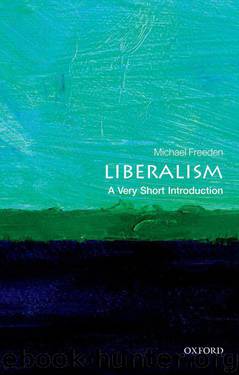
Author:Michael Freeden [Freeden, Michael]
Language: eng
Format: epub, mobi
ISBN: 9780199670437
Publisher: Oxford University Press
Published: 2015-06-25T07:00:00+00:00
The precise and the fuzzy
The morphological approach does not assume that ideologies have essences, or that their concepts have true meanings. That is a view held by some ideologues, ethicists, and philosophers. It relies instead on empirical evidence culled from many different sources to construct repeated and typical patterns of argumentation that can then be grouped together in an ideological family. Through exploring the recurring patterns of liberal language and discourse, we find liberalism emerging as a complex cluster of internal arrangements. The adaptability that follows in the wake of liberalism’s structural flexibility and tolerance is highly advantageous to an ideology engaged in endless competition over its survival in a harsh ideational environment. The permutations of liberalism, however, are filtered through the organizing constraints that the liberal core concepts impose on any of its versions. As with all ideologies, liberalism changes more slowly at its core and faster at its periphery. The former thus appears durable and in focus; the latter sits on shifting sands.
Approaching liberalism as a loose morphological arrangement, albeit one with distinct family resemblances, casts further light on the fragility of liberal boundaries. If liberal concepts are rearranged in different rankings, or if one or two of them are replaced by other concepts, liberalism can mutate into a neighbouring ideology. The boundaries between ideologies are not cast in stone. Ideologies may want to present themselves as unique and clear-cut, but an examination of their morphologies quickly reveals overlaps, shared areas, and mutual permeation. Crucially, it is not the presence or absence of ideas and concepts that differentiates one ideology from another, but the distinct patterns in which such imbricated or common components are assembled.
Another difficulty in analysing the credentials of those aspiring to liberal status is the tendency to inflate one of the core concepts at the expense of others. If liberals run with an attenuated layer two liberalism, emphasizing markets and the power of capitalist entrepreneurship alone but paying little attention to individual development or to autonomous and reflective choice, there is a risk that liberty as freedom to accumulate wealth may occupy too much of the core’s space, emaciating the partner core concepts. That may happen, however, when any core concept crowds out others, and the observer has to make a considered judgement on whether what remains in the core possesses a sufficient critical mass to deserve the label ‘liberalism’. This issue will be addressed in Chapter 7.
There exist of course other, nominal, standpoints of scholars, according to which we must accept that anyone who professes to be a liberal needs to be taken at face-value. That is not the position adopted by the morphological approach. Were we to accept self-declared nominalisms uncritically we would have, for example, to categorize the Nazis as members of the socialist community because they called themselves national socialists. That would, to put things mildly, stretch any reasonable understanding of interwar fascism beyond plausible limits. That is why self-definition by an individual or group—though unquestionably paramount in any investigation—must be
Download
Liberalism: A Very Short Introduction (Very Short Introductions) by Michael Freeden.mobi
This site does not store any files on its server. We only index and link to content provided by other sites. Please contact the content providers to delete copyright contents if any and email us, we'll remove relevant links or contents immediately.
| Anarchism | Communism & Socialism |
| Conservatism & Liberalism | Democracy |
| Fascism | Libertarianism |
| Nationalism | Radicalism |
| Utopian |
The Secret History by Donna Tartt(19012)
The Social Justice Warrior Handbook by Lisa De Pasquale(12179)
Thirteen Reasons Why by Jay Asher(8878)
This Is How You Lose Her by Junot Diaz(6866)
Weapons of Math Destruction by Cathy O'Neil(6253)
Zero to One by Peter Thiel(5778)
Beartown by Fredrik Backman(5723)
The Myth of the Strong Leader by Archie Brown(5488)
The Fire Next Time by James Baldwin(5421)
How Democracies Die by Steven Levitsky & Daniel Ziblatt(5207)
Promise Me, Dad by Joe Biden(5138)
Stone's Rules by Roger Stone(5072)
A Higher Loyalty: Truth, Lies, and Leadership by James Comey(4942)
100 Deadly Skills by Clint Emerson(4908)
Rise and Kill First by Ronen Bergman(4766)
Secrecy World by Jake Bernstein(4735)
The David Icke Guide to the Global Conspiracy (and how to end it) by David Icke(4693)
The Farm by Tom Rob Smith(4496)
The Doomsday Machine by Daniel Ellsberg(4477)
